Abstract
Long-Text Understanding (LTU) at million-token scale requires balancing reasoning fidelity with computational efficiency. Frontier long-context LLMs can process millions of token contexts end-to-end, but they suffer from high token consumption and attention dilution. In parallel, specialized LTU agents often sacrifice fidelity through task-agnostic abstractions like graph construction or indexing. We identify a key insight for LTU: query-relevant information is typically sparse relative to the full document, so effective reasoning should rely on a query-sufficient subset rather than the entire context.
To address this, we propose SCOUT, a new paradigm for LTU that shifts from passive processing to active information foraging. It treats the document as an explorable environment and answers from a compact, provenance-grounded epistemic state. Guided by state-level gap diagnosis, SCOUT adaptively alternates between coarse-to-fine exploration and anchored state updates that progressively contract its epistemic state toward query sufficiency.
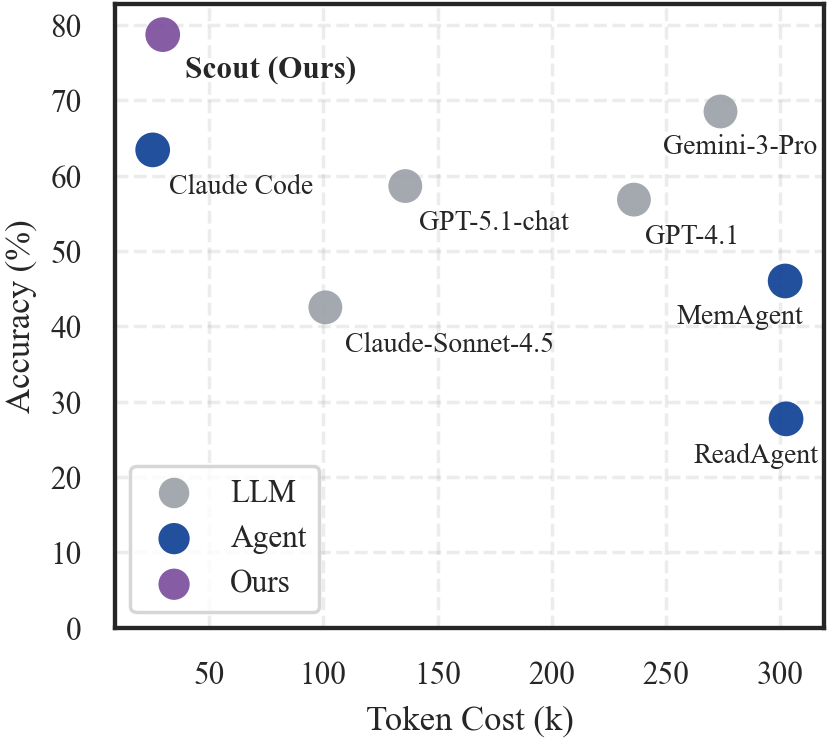
Experiments show that SCOUT matches state-of-the-art proprietary models while reducing token consumption by up to 8×. Moreover, SCOUT remains stable as context length scales, substantially alleviating the practical cost–performance trade-off.
The LTU Trilemma
We identify the LTU Trilemma: systems struggle to simultaneously satisfy three desiderata for million-token understanding. Existing paradigms each sacrifice at least one.
Scalability
Robustness as context length grows from 64K to over 1M tokens, without degradation in accuracy.
Information Fidelity
Faithful reasoning that preserves nuance and long-range dependencies without lossy compression or fragmentation.
Inference Efficiency
Low token cost that avoids brute-force ingestion of the full document, keeping inference practical at scale.
We trace the root cause to the Task-Agnostic Processing Trap: existing paradigms pre-process long documents (via indexing, compression, or encoding) without conditioning on the downstream query, misallocating computation to irrelevant regions while losing query-critical details. This motivates our information sparsity assumption—for a given query, the information needed to answer is typically a small, query-sufficient subset of the full document. Efficient LTU should therefore focus on discovering and consolidating this subset, rather than exhaustively processing the entire corpus.
“The agent need not digest the world; it need only learn to forage within it.”
Method
A common operationalization of on-demand information acquisition is the history-as-state agent (e.g., ReAct), where the growing interaction history Ht serves as both the navigation trace and the reasoning substrate. However, as Ht grows over long horizons, the signal-to-noise ratio decreases—most acquired observations fall outside the query-relevant set, contaminating the reasoning input.
SCOUT addresses this via state decoupling: it separates the interaction history (procedural trace, used only for navigation) from a compact Epistemic State (the sole substrate for answering). Each entry in the epistemic state is a provenance-anchored unit traceable to the source text. Crucially, the final answer is produced from the epistemic state alone, without access to the noisy interaction history.
Through iterative gap diagnosis, SCOUT assesses what information is still missing and directs subsequent foraging accordingly, progressively driving the epistemic state toward the minimal query-sufficient set.
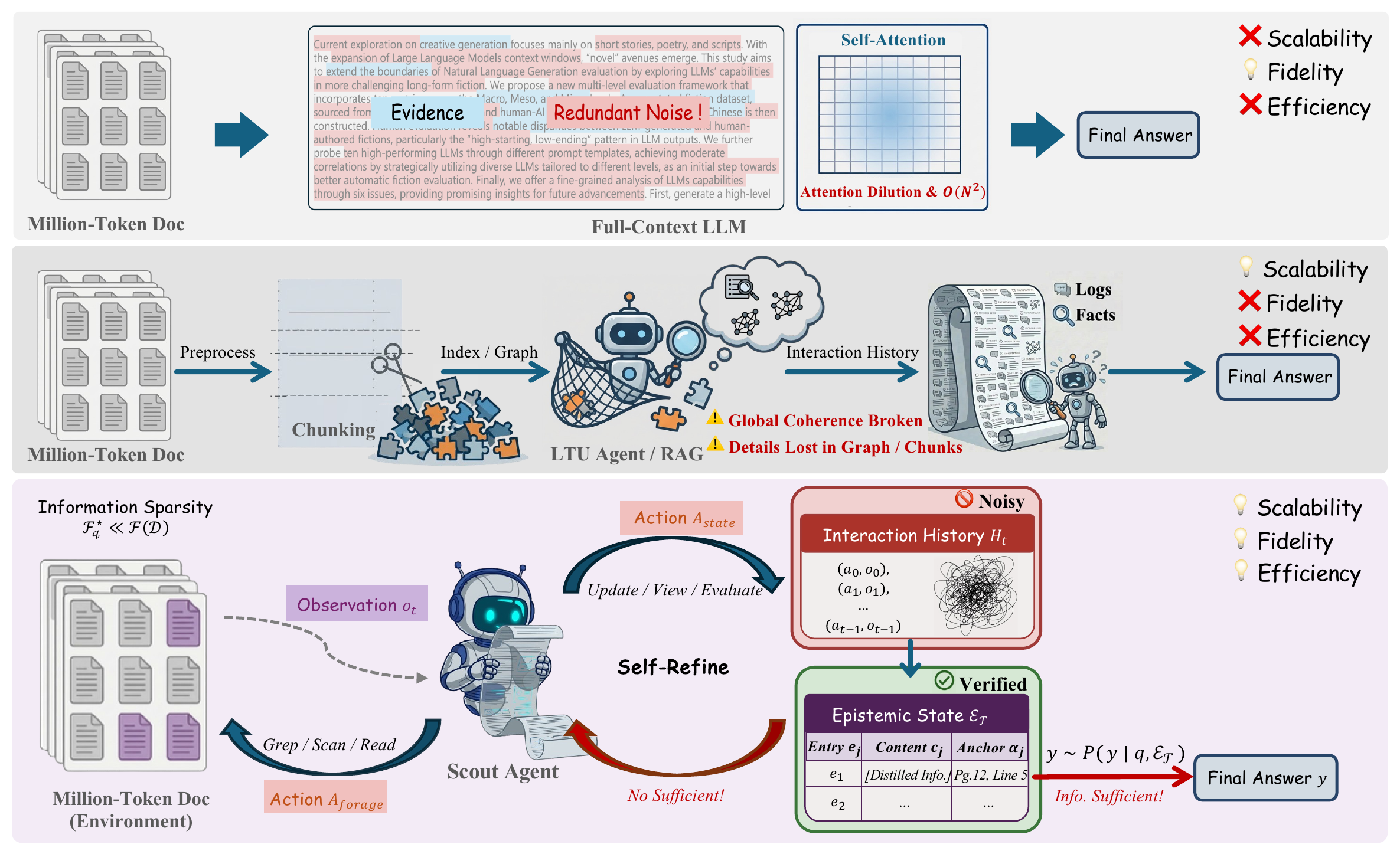
Paradigm comparison for million-token LTU and SCOUT's state-decoupled convergence. Top: Full-context LLMs ingest the entire sequence, suffering attention dilution and quadratic compute/memory growth. Middle: Chunking/RAG-style agents improve scalability via fragmented access, but coherence can break across long ranges and answer-critical details may be lost. Bottom (ours): SCOUT treats the document as an explorable environment and decouples procedural exploration (a noisy interaction history) from epistemic reasoning (a distilled state). Across steps, the agent distills anchored knowledge into εt and uses state-level diagnosis to guide foraging, progressively contracting εt toward query sufficiency.
Main Results
We evaluate SCOUT on two challenging benchmarks: LOOGLE-V2 (long-dependency reasoning) and ∞BENCH (ultra-long scale). Under a Unified Backbone Protocol (all agents use Claude-Sonnet-4.5), SCOUT achieves the highest accuracy on both benchmarks with the best token efficiency.
LOOGLE-V2
| Category | Method | Overall Acc (%) | Cost (k) | Token Eff. |
|---|---|---|---|---|
| LLMs | GPT-4.1 | 56.8 | 236.0 | 0.24 |
| Gemini-2.5-Pro | 56.2 | 258.1 | 0.22 | |
| Claude-Sonnet-4.5 | 42.5 | 100.9 | 0.42 | |
| GPT-5.1-chat | 58.6 | 135.9 | 0.43 | |
| Gemini-3-Pro | 68.5 | 273.9 | 0.25 | |
| Agents | ReadAgent | 27.7 | 302.6 | 0.09 |
| GraphReader | 31.6 | 408.1 | 0.08 | |
| MemAgent | 46.0 | 302.2 | 0.15 | |
| Claude Code | 63.4 | 25.3 | 2.51 | |
| Ours | SCOUT | 78.7 | 29.7 | 2.63 |
∞BENCH
| Category | Method | Overall Acc (%) | Cost (k) | Token Eff. |
|---|---|---|---|---|
| LLMs | GPT-4.1 | 73.0 | 212.7 | 0.34 |
| Gemini-2.5-Pro | 81.9 | 245.4 | 0.33 | |
| Claude-Sonnet-4.5 | 65.1 | 96.6 | 0.67 | |
| GPT-5.1-chat | 82.6 | 118.2 | 0.70 | |
| Gemini-3-Pro | 83.9 | 259.1 | 0.32 | |
| Agents | ReadAgent | 42.3 | 481.8 | 0.09 |
| GraphReader | 43.1 | 327.4 | 0.13 | |
| MemAgent | 68.1 | 264.0 | 0.26 | |
| Claude Code | 72.7 | 19.2 | 3.79 | |
| Ours | SCOUT | 85.6 | 21.4 | 4.01 |
Alleviating the LTU Trilemma
As context length scales from 64K to over 1M tokens, SCOUT maintains near-flat accuracy and near-constant token cost, while frontier monolithic LLMs degrade sharply in accuracy and see costs increase by orders of magnitude. SCOUT remains near the Pareto frontier, simultaneously achieving strong fidelity, efficiency, and scalability.
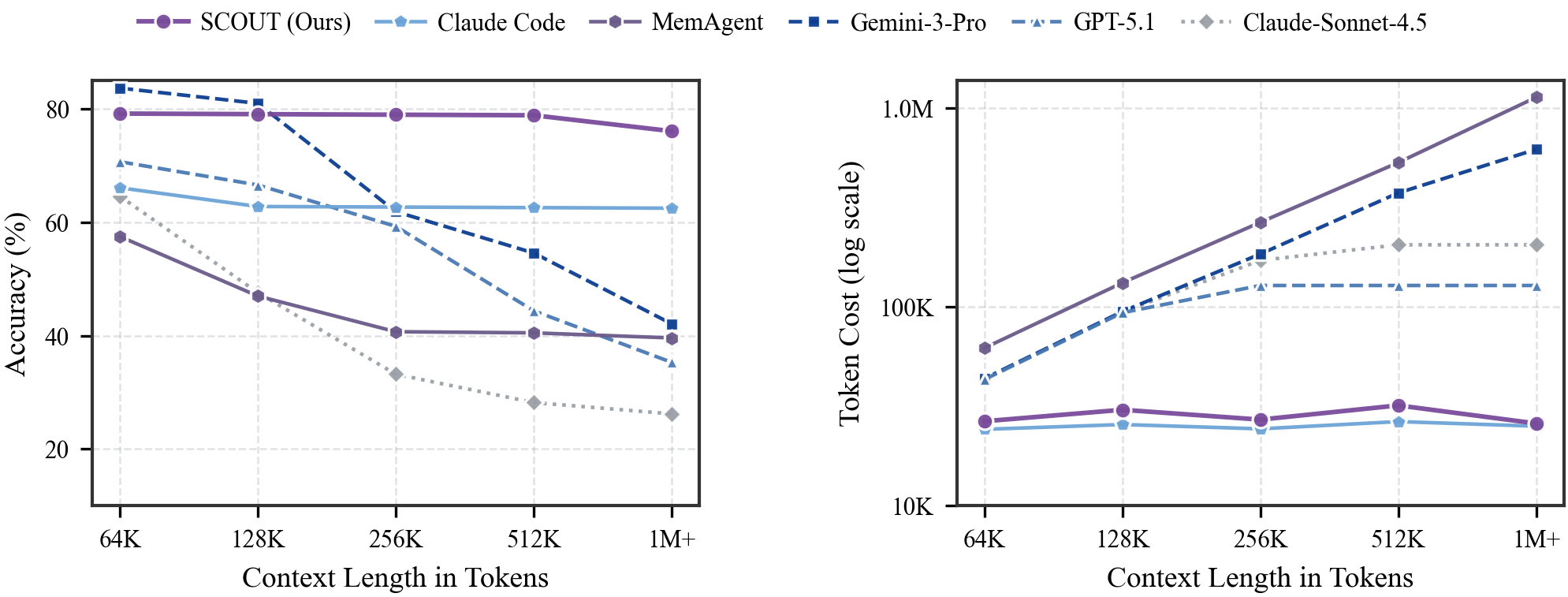
Alleviating the LTU trilemma under scaling. Left: as context grows from 64K to 1M+, SCOUT maintains near-flat, top accuracy, while frontier monolithic LLMs often degrade at long horizons. Right (log scale): SCOUT keeps token cost nearly constant, whereas monolithic ingestion costs grow rapidly with context length.
Training Gains under SCOUT
The same budget pays off only when paired with the SCOUT interface. When the backbone is trained and evaluated as a monolithic LLM, SFT yields only marginal gains and can even be neutral under a fixed budget. Training and evaluating the same backbone within the SCOUT paradigm produces substantially larger improvements under the same optimization-token budget (~60M tokens), and DAPO further amplifies these gains under the identical interaction protocol. Together, this gap indicates that the dominant bottleneck for open-weight backbones in million-token LTU is not raw parametric knowledge, but long-horizon interaction and state control; SCOUT supplies the missing structure.
| Backbone | Regime | LOOGLE-V2 (LLM) | LOOGLE-V2 (SCOUT) | ∞BENCH (LLM) | ∞BENCH (SCOUT) |
|---|---|---|---|---|---|
| Qwen2.5-72B | Vanilla | 24.0 | 28.3 | 49.4 | 53.2 |
| +SFT | 25.1 (+1.2) | 55.4 (+27.1) | 48.7 (-0.7) | 78.3 (+25.1) | |
| +DAPO | – | 35.1 (+6.8) | – | 60.8 (+7.6) | |
| Qwen3-30B-A3B | Vanilla | 40.8 | 41.2 | 55.5 | 65.4 |
| +SFT | 40.3 (-0.5) | 54.2 (+13.0) | 57.1 (+1.6) | 75.8 (+10.4) | |
| +DAPO | – | 45.1 (+3.9) | – | 68.8 (+3.4) |
Citation
@inproceedings{zhang2026scout,
  title={SCOUT: Active Information Foraging for Long-Text Understanding with Decoupled Epistemic States},
  author={Zhang, Zhenliang and Wang, Wenqing and Hu, Yong and Yang, Yaming and Gao, Jiaheng and Shen, Chen and Wan, Xiaojun},
  booktitle={Proceedings of the 43rd International Conference on Machine Learning (ICML)},
  year={2026}
}